


Loading product details
Preparing specifications, features and applications…
The BWF-12/07CR Muffle Furnace delivers precision high-temperature heat treatment for laboratory and industrial applications requiring reliable, programmable thermal processing up to 1200°C — with a 1100°C working temperature sustained by Fe-Cr-Al alloy heating elements and alumina ceramic fiber insulation engineered for minimal heat loss and exceptional temperature uniformity. At the heart of the BWF-12/07CR is a microprocessor PID controller with 7 programmable programs and 9 segments per program, enabling complex multi-ramp, multi-hold temperature profiles to be automated and repeated without operator intervention. Combined with a compact 7L chamber, Type K thermocouple sensing, ±1°C temperature uniformity, stainless steel outer construction, chimney design for improved combustion, and optional USB data logging, the BWF-12/07CR is the precise, programmable, and durable compact muffle furnace for material testing, ashing, sintering, and heat treatment in research and industrial laboratory environments. Enquire about the BWF-12/07CR today.
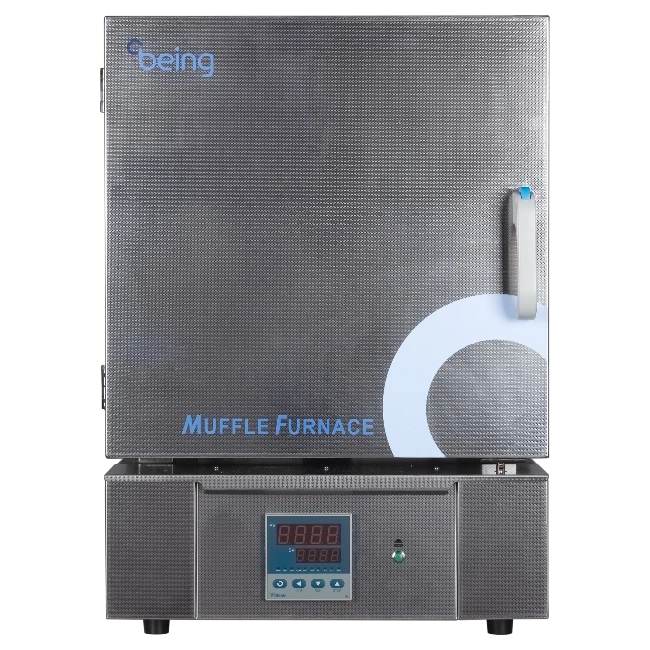
The BWF-12/07CR Muffle Furnace integrates Fe-Cr-Al alloy heating elements, alumina ceramic fiber insulation, microprocessor PID control with 7×9 programmable segments, Type K thermocouple sensing, and a chimney design — delivering ±1°C temperature uniformity up to 1200°C for compact laboratory ashing, sintering, heat treatment, and material analysis applications.
The BWF-12/07CR uses an iron-chromium-aluminium (Fe-Cr-Al) alloy resistance heating element — a material specifically selected for high-temperature furnace applications due to its superior oxidation resistance, high melting point, and exceptional resistance to thermal ageing. Fe-Cr-Al elements form a stable alumina (Al₂O₃) surface layer at elevated temperatures that passivates the element surface, preventing further oxidation and dramatically extending element service life compared to standard nickel-chromium (Ni-Cr) elements at temperatures above 1000°C. This high ageing resistance directly translates to lower long-term maintenance costs and more consistent heating performance throughout the BWF-12/07CR's operational lifetime.
The BWF-12/07CR's furnace chamber is lined with alumina ceramic fiber insulation — a high-performance refractory material with extremely low thermal mass and high thermal resistance. The ceramic fiber lining achieves two critical performance objectives simultaneously: it minimises heat retention in the chamber walls (enabling faster heating and cooling cycles than dense refractory brick furnaces), and it provides excellent insulation efficiency that reduces power consumption during temperature hold phases. The corrosion-resistant ceramic fiber material is also compatible with the gaseous atmospheres generated during ashing and sintering processes, maintaining its structural integrity and insulation performance under the chemical environments typical of material testing applications.
The BWF-12/07CR's microprocessor PID controller supports 7 independent programmable programs, each with up to 9 segments — enabling the storage and automated execution of complex multi-stage thermal profiles combining multiple heating ramps, temperature holds, and controlled cooling stages in sequence. Each segment independently defines the target temperature, heating/cooling rate, and hold duration — allowing precise replication of demanding heat treatment protocols, sintering cycles, and ashing procedures across repeated runs without operator involvement at each transition. The ability to store 7 different programs makes the BWF-12/07CR suitable for laboratories running multiple different material processing protocols on the same instrument.
The BWF-12/07CR achieves temperature uniformity of ±1°C throughout its 7L chamber — a performance specification that reflects the combination of ceramic fiber insulation for even heat distribution, Fe-Cr-Al element stability, and the PID controller's continuous modulation of heating power. ±1°C uniformity at working temperatures up to 1100°C is the critical performance requirement for quantitative material analysis applications — including loss-on-ignition (LOI) determination, thermal gravimetric preparation, and phase transformation studies — where temperature variation between different positions in the chamber would introduce systematic measurement errors.
The BWF-12/07CR incorporates a chimney design that promotes controlled airflow through the furnace chamber during heating — facilitating the complete combustion of organic materials during ashing applications, the efficient removal of volatile decomposition products from the chamber during heat treatment, and the prevention of atmospheric product accumulation that could otherwise compromise sample quality or contaminate the heating element and chamber walls. The chimney improves ashing efficiency by maintaining an oxidising atmosphere throughout the combustion process, supporting complete and reproducible sample decomposition at temperatures up to 1100°C working temperature.
The BWF-12/07CR's exterior is constructed from stainless steel — providing durability, corrosion resistance, and a professional laboratory appearance. The stainless steel outer structure protects the ceramic fiber insulation and internal components from physical damage during laboratory use, withstands the occasional chemical splash and cleaning procedures typical in material testing environments, and provides a low-maintenance exterior that retains its appearance over the BWF-12/07CR's operational lifetime. The compact exterior dimensions of 460 × 550 × 674 mm house the full functionality within a footprint suitable for standard laboratory bench or instrument stand installation.
The BWF-12/07CR uses a Type K (Chromel-Alumel) thermocouple as its primary temperature sensing element. Type K thermocouples are the standard sensing technology for high-temperature laboratory furnaces due to their wide temperature range (up to 1260°C for standard grade), good accuracy across the full 0–1200°C operating range of the BWF-12/07CR, and relatively low cost. The Type K sensor provides the primary temperature feedback signal to the PID controller, enabling the continuous measurement-based control loop that maintains ±1°C temperature uniformity throughout the furnace chamber during all programmed operational phases.
The BWF-12/07CR Muffle Furnace incorporates four independent safety systems — covering over-temperature alarm, multi-mode warning alerts, electrical protection against over-current, over-voltage and overheating, and automatic shutdown on door opening — to ensure safe, unattended operation during high-temperature laboratory and industrial heat treatment protocols.
The BWF-12/07CR continuously monitors chamber temperature via the Type K thermocouple and activates an over-temperature alarm if the temperature exceeds the user-configured upper safety limit. In a furnace operating at temperatures up to 1200°C — where undetected over-temperature conditions can damage samples, degrade the heating element, compromise the ceramic fiber chamber lining, and create fire or structural safety risks in the surrounding laboratory environment — an active over-temperature alarm provides the earliest possible warning for operator intervention. The alarm activates independently of the PID control system, providing protection even if the primary controller malfunctions.
The BWF-12/07CR provides both audible and visual alarm outputs for all warning conditions — including over-temperature, door open status, and system fault states. The dual-mode alarm system ensures that warning conditions are communicated to operators regardless of their proximity to the furnace and regardless of whether they are able to monitor the LCD display directly. In laboratory environments where high-temperature furnaces are operated in shared workspaces with background noise, the audible alarm component is particularly important for ensuring that safety-relevant warning conditions are not missed during active laboratory working periods.
The BWF-12/07CR incorporates electrical protection circuits covering over-current, over-voltage, and overheating conditions — providing three independent layers of protection against the electrical fault conditions that present the greatest risk to a 3kW high-temperature furnace operating continuously in a laboratory environment. Over-current protection prevents damage from wiring faults and component failures; over-voltage protection guards against supply voltage spikes that could damage the PID controller electronics and heating element; and over-heating protection provides thermal protection to the electrical components housed in the furnace control section, preventing heat-related component failure during extended high-temperature operation.
The BWF-12/07CR automatically shuts down or reduces heating when the furnace door is opened — providing critical protection against the hazards associated with opening a furnace operating at temperatures up to 1200°C. Automatic shutdown prevents sudden high-intensity thermal radiation exposure to the operator during door opening, protects against rapid temperature excursions caused by cold air influx into a maximally heated chamber, and prevents heating element overexposure to cold air that can cause thermal shock damage to Fe-Cr-Al elements at operating temperature. This automatic response is a fundamental safety feature for high-temperature muffle furnace operation.