Loading product details
Preparing specifications, features and applications…
The VRI-4 Oil Rotary Vane Vacuum Pump is the compact entry model of the VRI/VRD Series — delivering dual-stage rotary vane vacuum pumping at 4 m³/h with a 1×10⁻¹ Pa ultimate partial pressure (3 Pa ultimate total pressure) for stable, reliable vacuum supply to laboratory vacuum ovens, drying systems, chemical processing setups, and general vacuum applications. The VRI-4 integrates key performance features that distinguish it from basic rotary vane designs: a built-in gear pump ensuring continuous steady oil supply to the rotating vanes for sustained vacuum performance, an electric solenoid valve that automatically prevents oil backflow into the connected vacuum system during power failure or shutdown, IP44 environmental protection, and single-phase 0.37 kW motor at 1440 rpm — all within a compact 337 × 138 × 244 mm format weighing only 11 kg. Enquire about the VRI-4 today.
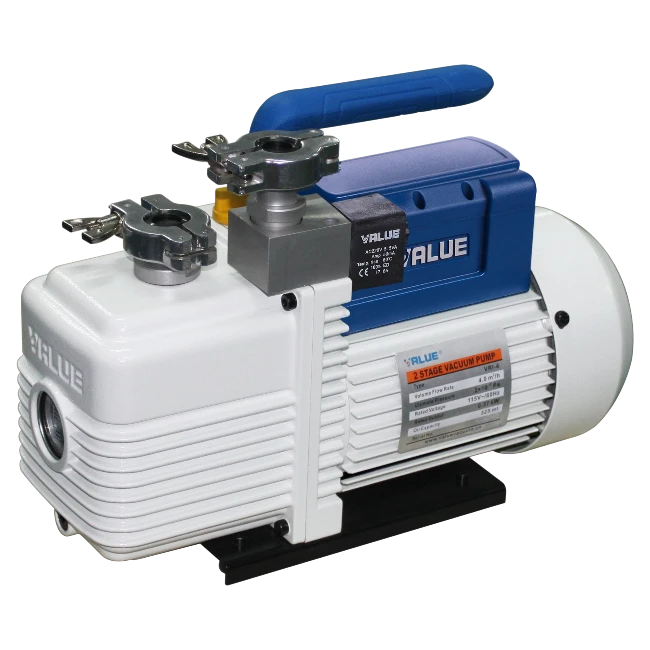
The VRI-4 Oil Rotary Vane Vacuum Pump delivers dual-stage 4 m³/h rotary vane vacuum performance with built-in gear pump for steady oil supply, electric solenoid anti-backflow valve, integrated pump-motor design, IP44 protection, and ≤62 dB quiet operation — providing stable, reliable deep vacuum supply for laboratory vacuum ovens, drying systems, and general vacuum applications.
The VRI-4's dual-stage (two-stage) rotary vane mechanism routes gas through two compression stages in series — the exhaust of the first stage becoming the inlet of the second stage. This series arrangement allows the VRI-4 to achieve the 1×10⁻¹ Pa ultimate partial pressure and 3 Pa ultimate total pressure that a single-stage rotary vane pump cannot reach, providing the deep vacuum levels required for efficient laboratory vacuum oven drying at 133 Pa and below, vacuum distillation, freeze-drying support, and other laboratory applications requiring consistently deep vacuum. The two-stage compression provides both deeper vacuum and more stable vacuum maintenance under gas load than single-stage alternatives at equivalent pump size.
The VRI-4's integrated gear pump continuously circulates lubrication oil through the pump mechanism during operation — ensuring a steady, uninterrupted oil film across the rotating vanes, rotor, and stator surfaces throughout the full operating cycle. Consistent oil supply is the critical maintenance requirement for rotary vane vacuum pump performance: inadequate oil film leads to vane wear, reduced vacuum performance, increased noise, and shortened pump service life. The built-in gear pump eliminates the oil starvation events that can occur in gravity-fed designs during orientation changes, high-speed operation, and extended continuous duty cycles.
The VRI-4's electric solenoid valve is mounted at the pump inlet and automatically closes when power is interrupted — preventing the oil backflow (oil suck-back) that occurs when a rotary vane pump coasts to rest with the vacuum system still connected. Oil backflow contaminates the connected vacuum system (vacuum ovens, drying chambers, analytical instruments) with pump oil — a critical problem for pharmaceutical and analytical applications where oil contamination would compromise product purity and analytical instrument integrity. The automatic solenoid closure eliminates this risk without requiring manual valve operation by the operator.
The VRI-4's compact 337 × 138 × 244 mm exterior and 11 kg weight make it the most space-efficient model in the VRI/VRD Series — suitable for placement directly on a laboratory bench beside connected vacuum ovens or under-bench positioning adjacent to drying systems, rotary evaporators, and vacuum manifolds. The lightweight design enables easy repositioning between different connected vacuum applications without mechanical handling assistance.
The VRI-4's integrated pump-motor design directly couples the single-phase 0.37 kW motor to the rotary vane pump mechanism — eliminating belt, coupling, and shaft seal components that add maintenance requirements and failure modes to indirect drive designs. The integrated design reduces the VRI-4's overall dimensions and weight, improves mechanical efficiency by eliminating power transmission losses, and ensures consistent performance without the drive component wear that progressively degrades vacuum performance in belt-driven pump configurations.
The VRI-4 operates at ≤62 dB — a laboratory-compatible noise level suitable for shared open-plan laboratory environments without acoustic enclosure. At 4 m³/h compact scale, the VRI-4's rotary vane mechanism generates the low mechanical noise characteristic of oil-lubricated rotary vane pump operation, significantly quieter than equivalent-flow diaphragm pumps or dry-running claw pumps. The ≤62 dB level enables operation alongside sensitive analytical instruments without acoustic interference.
The VRI-4's oil-lubricated rotary vane mechanism provides long service life through continuous lubrication of the wear surfaces — significantly longer than oil-free diaphragm pumps where the diaphragm and valves require periodic replacement under normal operating conditions. The dual-stage mechanism's inherent efficiency means the vanes operate under lower differential pressure per stage compared to single-stage designs, reducing wear rates and extending the service interval between vane replacements.
The VRI-4 incorporates three safety systems — solenoid valve prevention of oil suck-back during power failure, stable vacuum retention, and reliable motor protection — ensuring safe continuous laboratory vacuum operation without oil contamination of connected equipment during pump shutdown or power interruption events.
The electric solenoid valve is the VRI-4's most critical safety feature — automatically sealing the pump inlet upon power interruption before the pump mechanism decelerates. Without this protection, coasting pump vanes create a momentary reverse pressure gradient that draws oil from the pump sump into the connected vacuum system — contaminating vacuum ovens, analytical instruments, and process equipment with pump oil. The VRI-4's automatic solenoid closure makes unattended laboratory vacuum operation safe without manual valve management.
The VRI-4's dual-stage mechanism and efficient oil sealing provide stable vacuum retention — maintaining achieved vacuum levels in the connected system even as gas load varies during active drying, evaporation, or chemical processing operations. Stable vacuum retention prevents the pressure fluctuations that disrupt delicate vacuum drying processes, cause bumping in vacuum distillation, and introduce variability in analytical vacuum applications.
The VRI-4's single-phase motor incorporates thermal protection — shutting down automatically if the motor temperature exceeds safe limits during extended continuous operation or restricted ventilation conditions. Motor thermal protection prevents winding burnout during the sustained continuous duty cycles of laboratory vacuum oven drying operations, maintaining reliable vacuum supply for long-duration unattended laboratory vacuum processes.
Explore alternative models and related solutions from other categories