


Loading product details
Preparing specifications, features and applications…
The RV-21A Rotary Evaporator is the compact, small-scale entry in the RV Series — engineered for academic research laboratories, small-scale chemical sample processing facilities, and analytical laboratories requiring efficient, precise solvent evaporation in a space-conscious benchtop format. Combining a DC brushless motor with a 20–300 rpm rotation speed range, 8 mbar ultimate vacuum capability, automatic lifting mechanism, and PTFE vacuum sealing — all housed in a compact structure — the RV-21A delivers reliable reduced-pressure evaporation performance for 1L rotary flask applications. With a 1000W heating bath, vertical condenser with 1.7L capacity, and 1L collection bottle, the RV-21A is purpose-built for small-batch solvent recovery, chemical sample concentration, and laboratory-scale distillation. Enquire about the RV-21A today.
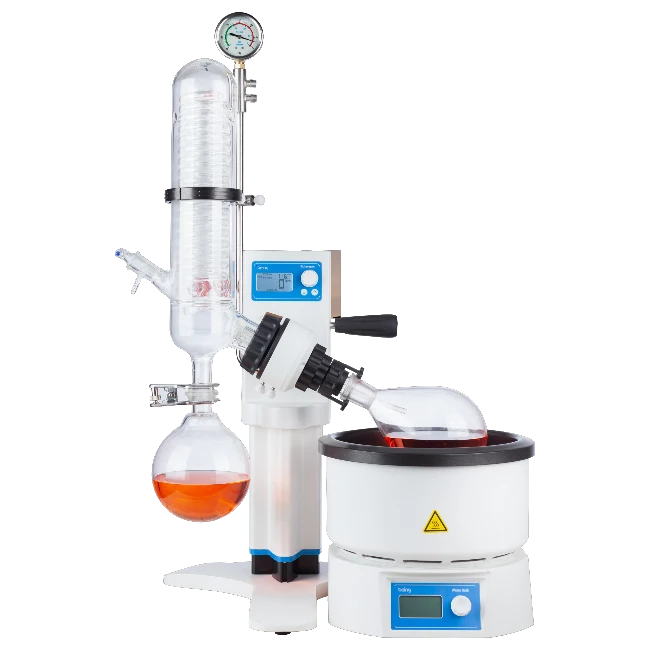
The RV-21A Rotary Evaporator integrates a DC brushless motor, 20–300 rpm rotation range, PTFE vacuum sealing, automatic lift, and vertical condenser design in a compact structure — providing reliable small-scale solvent evaporation performance for academic and research laboratory applications.
The RV-21A is designed as a compact rotary evaporator specifically optimised for small-scale laboratory environments where bench space is limited. Its streamlined structure accommodates a 1L rotary flask and 1L collection bottle within a minimal footprint — making it suitable for analytical chemistry workstations, academic teaching laboratories, and small research group installations where a full-size 5L or 20L rotary evaporator would be impractical. The compact design does not compromise on core performance specifications — the RV-21A achieves the same 8 mbar ultimate vacuum as larger models in the RV Series.
The RV-21A uses a DC brushless motor to drive the rotary flask — a motor technology that offers significant advantages over brushed motor systems in laboratory equipment. Brushless motors eliminate the carbon brush wear mechanism that causes gradual performance degradation and requires periodic maintenance in brushed motor designs. The result is more consistent torque delivery across the full 20–300 rpm speed range, quieter operation, longer motor service life, and reduced maintenance requirements — all relevant benefits for a laboratory evaporator expected to run reliably over thousands of operating hours.
The RV-21A is operated via an LCD display combined with an intuitive knob control interface — providing clear real-time visibility of rotation speed and bath temperature setpoints during evaporation. The knob control enables smooth, continuous speed adjustment across the 20–300 rpm range without the step increments of push-button systems, allowing operators to find the optimal rotation speed for their specific solvent and flask fill volume. The LCD display provides unambiguous parameter readout at the bench even under the bright lighting conditions of active laboratory environments.
The RV-21A's automatic lifting mechanism raises and lowers the rotary flask into and out of the heating bath with controlled, motorised movement — eliminating the manual effort and inconsistency of manual lift systems. The automatic lift ensures that flask immersion depth is reproducible between runs and between operators, contributing to consistent evaporation rates across repeated processing sessions. It also allows the flask to be rapidly raised out of the bath in response to alarm conditions or unexpected process events, protecting heat-sensitive samples from over-exposure to the heating bath.
The RV-21A's vacuum system incorporates PTFE (polytetrafluoroethylene) sealing throughout the rotary joint and vacuum path — providing chemical resistance to the broad range of organic solvents, acids, and corrosive chemicals commonly processed in rotary evaporators. PTFE's inertness prevents seal degradation, swelling, or permeation when exposed to aggressive laboratory solvents including acetone, dichloromethane, ethanol, methanol, hexane, and toluene — maintaining the vacuum integrity of the 8 mbar system across repeated solvent processing cycles and extending seal service life compared to standard rubber or silicone seal alternatives.
The RV-21A's rotation system delivers smooth, vibration-free orbital motion across its full 20–300 rpm range — ensuring consistent thin-film formation on the inner surface of the rotary flask that is the primary heat transfer and evaporation mechanism in rotary evaporation. Unstable or vibrating rotation disrupts the thin-film layer, reduces the effective evaporation area, and can cause sample bumping — a sudden, violent eruption of boiling liquid that contaminates the condenser and causes sample loss. The RV-21A's stable rotation mechanism prevents these disruptions and supports consistent, bump-free evaporation across the full speed range.
The RV-21A Rotary Evaporator incorporates targeted safety protections covering motor integrity, over-temperature prevention, and vacuum stability — ensuring safe, reliable small-scale solvent evaporation in academic and research laboratory environments.
The RV-21A's DC brushless motor incorporates built-in electronic protection that monitors motor operating parameters — including current draw, temperature, and rotation feedback — and activates protective shutdown if any parameter exceeds safe operating limits. This motor-level protection prevents damage from mechanical overload (such as flask imbalance at high speed), electrical faults, and thermal stress during extended operation — protecting both the motor and the rotary evaporator's mechanical drive components from damage that would otherwise require service intervention.
The RV-21A's heating bath system includes an independent over-temperature protection circuit that monitors bath temperature and cuts heating power automatically if the temperature exceeds the safe upper limit beyond the setpoint — independently of the primary temperature control system. This protection is critical during unattended evaporation sessions with volatile solvents, where an unchecked temperature excursion could accelerate solvent vapour generation beyond the condenser's capacity, increase system pressure, or damage heat-sensitive samples being processed in the 1L rotary flask.
The RV-21A's PTFE vacuum sealing system maintains stable vacuum integrity at the rated 8 mbar ultimate vacuum level throughout the evaporation cycle. Stable vacuum operation is both a performance and safety requirement in rotary evaporation — sudden vacuum loss causes an immediate pressure increase inside the rotary flask, which can trigger vigorous boiling (bumping), rapid solvent vapour release into the laboratory environment, and potential implosion or explosion of glass components under the resulting pressure differential. The PTFE seal integrity of the RV-21A's vacuum circuit maintains the controlled pressure environment essential for safe solvent evaporation.
Explore alternative models and related solutions from other categories